|
Georgian Culture |
| |
|
Georgian Music |
| |
Georgian music culture is acknowledged in many countries of the world.
The existence of first-rate symphony orchestras, musical theatres in
different cities, musical schools, distinguished original national
school of composers seem unbelievable if one takes into account the fact
that the academic music as understood under European standards counts
only a number of decades. In fact it originated at the end of the XIX
and the beginning of XX centuries. The prerequisite for the swift
development lies in the high
 |
|
potential and ancient history of the
Georgian musical culture. The AD manuscripts give information on
Georgian civilization - Sumerian cuneiform inscriptions mention the
original musical rituals of the tribes residing on the territory of
Georgia. The archaeological excavations revealed the ancient musical
instruments, salamuri (pipe), changi (string instrument) etc. dated back
to XVIII - XXV AD. The importance of music in the lives of Colchis and
Iberians was stressed by ancient Greek historians Herodote, Xenophon,
Strabone…
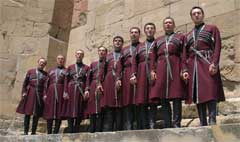
Folk music, namely polyphonic choir performance traditions have a
special place among the cultural values of the Georgian people. The
Georgian folk music can be considered unique without any exaggeration in
the world music culture.If we imagine the world music map, we shall see
that Georgia is a polyphony oasis in the desert of monody, one part.
Musical traditions
The tradition of polyphony has been preserved from ancient times till
today.
Every region of Georgia has its own tradition of specific musical
dialect and the manner of performance, none the less all of them share
the same intonation and harmony characteristics. Here the parallel can
be made with the diverse nature of the country. It is the style that
occurs in three specific forms from: the complex polyphony found in
Svaneti, whereby all the voices follow the same rhythmic pattern,
producing choral progression; the polyphonic dialogue typical of
 |
|
Eastern
Georgia with two high voices over a drone bass; and the contrastive
polyphony widespread in Western Georgia and characterized by
predominantly three-part writing. Georgian folk songs are generally
written in three-part polyphony, though four-part writing is also found,
as is clear from Gurian and Adzharian work songs. Unison singing has
survived in a few mountainous regions such as those inhabited by the
Khevsurians and Tushetians, and individual examples of monophonic songs
are occasionally found in both Western and Eastern Georgia. They include
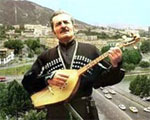
work, cradle, burial and mourning songs and are sometimes accompanied by
native instruments.
It is natural that the rich musical tradition gave birth to the
professional ecclesiastic music right after the introduction of
Christianity in Georgia (4th century).
This genre was especially developed in local ecclesiastic academies and
schools (Gelati, Ikalto) and the Georgian cultural centers abroad
(Jerusalem, Athoni, mount Sina, Petritsoni (Bulgaria)). The collection
of hymns of VIII-X centuries (the most famous of which are the hymns of
Michael Modrekili of IX-X cc.) provide with the wide variety of texts
and original musical symbols. Georgian and foreign researchers are
working to decipher them.
| |
 |
All these songs reflect the creative imagination of the Georgian nation,
its highly developed auditory sensitivity and complex and sophisticated
musical thinking. It is no accident that in 1977 a recording of the song
Chakrulo was launched into space on board an American space probe as an
example of humanDue to historical and political situation Georgian
culture was cut from the main stream of development of the European
musical culture. Only in the XIX century despite the annexation of
Georgia by Russia and the subsequent colonial policy and Russification,
Georgia began to develop its academic national musical culture with the
orientation to the civilization. European music. The acquaintance with
the European opera brought about the development of this genre and in a
number of years the national operas were created by the composers Z.
Paliashvili, M. Balanchivadze, D. Arakishvili and V. Dolidze. The 20ies
- 30ies of the 20th century were marked by the development of chamber
and symphony music genres.
Georgian Congregational Song
Christianity became the state religion of Georgia in the first half of
4th century, in 326. Since that time, Christian cathedrals are built and
divine services are conducted and, accordingly, Christian church singing
began. Originally, Georgian church singing underwent foreign influence.
That influence came from Palestine and Syria, on the one hand, and
Byzantine, on the other hand. But the original hymnographical patterns
are created since the 5th century. Georgian church singing of the 7th
century was already liberated from foreign influence. The stream of
polyphony came into church singing, that caused nationalization of
Georgian songs of wordship. This process was based on the abundance of
the elements of folk music, which depended more in the following
centuries. |
|
PROFESSIONAL MUSIC
The originality of Georgian musical culture is an absolute fact for everybody
even slightly acquainted with it. As an inseparable part of the national culture
since times immemorial it has shown the current processes in the everyday and
spiritual life, in the thinking and artistic imaginations of the Georgian i
tribes first and then of the Georgian nation. Culture in general, as well as
Georgian culture, is a collective phenomenon and, as it is said, it comprises
its own present, past and future; it has a memory, which guarantees the
continuity of its traditions Tin- history of Georgian musical culture-the
be-ginning of which is lost in the depths of millennia, and the result of
which-the highly developed many-voiced singing, is the pride of the Georgian
nation, is its proof as well. This history of developed so that in the periods
of ancient pagan and the following early Middle Ages culture maintained active
relations with the civilizations of the ancient Mediterranean area, then with
the antique civilian ions and at last with the Christian civilizations. It is
not difficult to trace the relations in the similarity, which depicts the ideas
of fighting with Gods and gaining fire in the Sumerian "Gilgameshiani", 3rd
millennium BC, in the Georgian "Amiraniani", 2nd millennium BC and in the Greek
myth about Prometheus at a later period.
The monuments of the material culture of the
same period prove that the theatrilized religious mysteries and cult-rituals
born in the world-outlook imaginations and artistic thinking of our ancestors
were factually
the same as the world-outlook expressed in the typical forms of the then Near
East-Old Egyptian, Sumerian-Babylonian, Palestinian (Old Hebrew) and Mycenaean
cultures. The corroboration of the existence of the Perkhulis (round dance) of
those times are of particular importance for us (the circle, as a symbol of the
wholeness and perfection of the universe), and the archaic musical-choreographic
ritual acts preserved up to the present times in one of the most ancient parts
of Georgia-the mountainous Svaneti, and among them the so-called "Amiran's
Perkhulis" with many-voiced singing, which clearly shows the continuous heredity
of the Georgian musical culture.
There are different opinions about the Georgian
singing being many-voiced as early as in the pagan period. An interesting
supposition is expressed by N. Mamisashvili, that the original system of the
Georgian traditional musical thinking, whose peculiarity is the extension of
sounds in the double-quintal-quarter "special diameter" must have been
established at the junction of the 6th-5th centuries BC. On the basis of written
sources we can already speak of "the originality of a peculiar kind" (Xenophon,
6th-5th c. BC) of war-songs or Perkhuli songs sung by the ancestors of
Georgians. Whether this "peculiarity" meant only many-voiced singing for the
Greek historian, whose ear was accustomed to listening to unison songs, cannot
be proved, but one thing is a fact, that this "peculiar" singing tradition, many
centuries later, in the 10th-11th c.c. of the Common Era preconditioned the
original form of the unique many-voiced church chant in the whole Christendom of
those times.
A new stage of the development of Georgian
musical culture began by declaring Christianity the state religion (4,h c. AD).
From that time on Georgian people have always had to fight to defend their
national sovereignty. The lot, so typical for a small country, was especially
hard for Georgia, being surrounded by the countries of quite different cultural
orientations, it had to pay hard for the relationship not only with openly
hostile forces, such as Iranians, Arabs, Mongols or Turks, but with the
countries of the kindred cultural and religious conception as well, for example,
in the remote past with Bizantium and for the last two centuries with Russia. In
such relationships with this multifarious world Georgian Christian culture, as
well as its musical culture, was being shaped, the latter formed a new channel
parallel to the old one in the national musical consciousness and from the
4lh-5lh centuries AD the professional compositional system of thinking was
started, which was different from folklore. This was a qualitatively new
phenomenon for the artistic-aesthetic world of Georgians. It originated from
that model of relationships of cultures, according to which it is easier for the
established original culture to assimilate an alien tradition. This process was
taking place in Georgia under the badge of the conception of Byzantine or rather
general Christian culture by the national culture, and it was penetrating into
every sphere, from the mode of everyday life including architecture, literature
and music. At the same time the national consciousness tried to establish new
cultural values in an assimilated way on the basis of national traditions. This
is manifested in the monumerits of the Georgian literature and architecture of
pre-Christian times, but in our opinion, the idea of national originality was no
less vividly expressed in music.
What we now call the old professional Georgian
music is a highly developed vocalic polyphony. It is actually the result of the
perception of Byzantine Christian monadic hymns by the Georgian pagan
many-voiced singing culture. The one-voiced Byzantine chant, whose origin can be
found in Old Hebrew hymns and which came to Georgia together with the rules of
the divine service, gradually received many-voiced forms usual for the Georgian
musical thinking.
The compositional-technological logic of music
was mainly based on the system of eight voices established in the orthodox
church practice by John of Damascus. Eleven manuscripts of the 10th-13th
centuries hymnography selections reached us; their texts are marked by the
original musical signs which are different from those of Byzantium. It is known
that three Georgian manuscripts found in the monastery on Mt. Sinai at the
beginning of the 20th century. Unfortunately, like those of Paleobyzantine ones,
the Georgian musical neums of the early Middle Ages have not been deciphered
yet. The latest researches in music (M. Khvtsiashvili) showed that in the
practice of the autocephaly Georgian Church there existed such highly developed
liturgic-musical sincrietic forms as, for instance, "Passion"-a musical setting
of the Biblical story of Christ's death.
The classical three-part vocal polyphony was
already established in the 10lh-11lh centuries. The Georgian Theo philosophical
teaching (Ioane Petritsi), which explains the principle of the wholeness of the
Christian Trinity by the analogy of the merging of three-voices in the Georgian
singing, is a proof of it; it is also noteworthy that the classical period of
the Old Georgian professional music coincided with the "Golden Age" of the
Georgian culture, national statehood and world-outlook and artistic thinking.
Culture, as a system, is an integral phenomenon. It is only natural that
Georgian church music, an integral part of Georgian hymnography, which was
highly developed at that time, should have attained its classical perfection
together with poetry. We think that polyphony is one of the main features of the
Georgian traditional artistic thinking generally. It is shown not only in
Petritsi's understanding of the Divine Trinity, but also in the Georgian linear
writing and in the ability of Rustaveli to see the universe in "countless
colors", but polyphony is, first of all, a category of musical thinking and that
is why it was most perfectly expressed in the nation's musical perception of the
universe. It is in the polyphony, that the idea of the heredity of the Georgian
traditional musical thinking was expressed, it is in the polyphony that the
wholeness of the pre-Christian and Christian musical world perception is
reflected.
Thus, we may say, that Old Georgian
professional music-the Georgian vocal polyphony generally expresses the
national- musical consciousness but at the same time it is a symbol of the
concrete Christian-epoch musical consciousness and it is an original phenomenon
in the whole Christian musical culture, imprinted by such spiritual and moral
peculiarities by which the Georgian nation enriched the treasury of the art of
mankind. Unfortunately, mankind knows very little about this acquisition as yet.
The memory of the national musical culture
preserved the knowledge of vital importance about the historically established
artistic-aesthetic orientation of its own. This is the very knowledge that
conditions its choice at the decisive stages of history. After adopting
Christianity the Georgian nation often faced the danger of physical destruction,
but it never betrayed the once chosen European orientation. The same happened at
the end of the 18th century, when Georgia, weakened by her endless struggles for
physical and spiritual survival, sought an ally in Russia, the country of the
same religion. Today it is impossible to estimate this fact in a simple way even
from the point of view of Georgian musical culture; on the one hand, Georgian
lost its sovereignty, Georgian church had become auto cephalic as early as the
5lh century; such strong symbols of the Georgian national-cultural originality
as the Georgian word and the Georgian chant were banished.
At the same time the compositional-technological conception of the old
professional music sank into oblivion. On the other hand Georgian musical
culture restored the age-long broken relations with European culture through
Russia. The notation of folk-songs and several thousands of ecclesiastic chants,
which had been preserved by oral tradition for millennia, became possible. A
solid foundation was laid for the professional musical education, which soon
became systematic and was crowned by opening a higher musical institution-a
conservatoire in 1917. But while the small Georgian nation, living on the border
of Europe and Asia, was fighting a desperate fight for saving the cultural
values which had passed through centuries, as well as for preserving and
protecting the original folk and professional polyphony, European musical
culture reached unprecedented levels by natural evolutionary development. All
this was to be taken into consideration by the culture that was historically
oriented to the European culture. That is why it is not difficult to explain a
special interest of the Georgian musical thinking of traditionally polyphonic
structure in the highly developed many-voiced European music.
Beginning from the latter half of the 19th
century Tbilisi was the most important musical and cultural center of the
Russian Empire. The second large town-Kutaisi was distinguished by its intensive
musical life as well. Thus, the establishing of the new Georgian musical culture
of the European kind was preceded by the opening of the Opera House in 1851,
which hosted first the Italian and then Russian companies; the
musical-educational activities of Russian musicians, fruitful relations with
other layers of European music-catholic music, German, Polish, French music, the
richest experience of relations with the Oriental musical culture. In short, by
the beginning of the 20lh century Georgian musical culture had acquired a wide
range of vision. This gave it a possibility to choose its own way of
development; for instance, the desire to create a national opera was not only
merely the desire to bring this genre, so popular in Europe, to Georgia. This
was the desire of the highly developed folk and professional singing culture to
give a new life to the traditional musical idea under new conditions.
All that happened in the new Georgian
professional music during one century (the first specimens of artistic value of
the new Georgian music-M. Balanchivadze's romances, were created in 1889) show
the fastest evolution of the national composition thinking. The establishment of
the European vocal, vocal-instrumental or purely instrumental forms and genres
in the Georgian musical thinking meant significant changes, such as the breaking
up of the traditional non-tempered system of the sound order, the combining of
modal relations with tonal ones, and as a whole, the creation of such a new
timbre-into-national word which would be genetically connected with the age-long
folk and professional musical tradition; and, at the same time it should reflect
the modern world-outlook of the Georgian nation, which had already shared the
modern cultural experience. Taking into consideration all this enabled Zakaria
Paliashvili to perfectly realize the symbolic idea of the national spirituality
in his immortal opera
"Abesalom and Eteri" (1919) and at the same time to give his opera a
supranational, general meaning. The same qualities characterize the choral
creations of Niko Sulkhanishvili. In short, the classics of the new Georgian
music: Meliton Balanchivadze, Dimitry Araqishvili, Viktor Dolidze, Niko
Sulkhanishvili and Zakaria Paliashvili started and created classical heritage in
the vocal genres: romance, opera, choral music.
From the 20s of our century, when the so-called Soviet period, lasting seventy
years, began, the new generation of Georgian composers set a goal to establish
instrumental genres and in the following decades this aim was achieved
successfully. By and by the multifariousness of the genres of Georgian music and
the main artistic-aesthetic tendencies became clear-cut, the technological
conception was established, which benefited mainly from the achievements of the
Russian-European classical-romantic musial art, but at the same time revealed
the individual style of separate composers. In the 30s and 40s new
representatives of Georgian music appeared, who created many works in different
genres. They have already become classical works of our national music. We must
mention Andria Balanchivadze and Shalva Mshvelidze in symphony, Shalva
Mshvelidze and Otar Taktakishvili in opera oratorio, Andria Balanchivadze, David
Toradze and Alexi Machavariani in ballet, Sulkhan Tsintsadze in instrumental
chamber music. Revaz Laghidze and David Toradze in songs, Mary Davitashvili in
children's music, etc.
The 60s for Georgian music were the turning
point in style and a new stage of development started. It is not difficult to
find the determinant of this qualitative leap. On the boundary of the 50s and
60s in the whole area of the Soviet ideology the tendency of liberalization grew
stronger and the so-called "thawing" relief was felt by Georgian music as
well-it escaped the demand of reflecting the conflict less reality and got
acquainted with the richest experience of the musical practice of the 20th
century. This was a new vision of the world expressed by technological
innovation. Individual composition thinking gets free of all the conventionality
and it becomes possible to use any technique of composition or means of
expression suitable for the artistic aim. In short, the current processes in
Georgian music from the 60s up to the present day have two sides: its charm is
in the widening of the scope of musical culture, in striving towards something
that is common to all mankind, to generally ethical, to generally aesthetic
values. At the same time there is a danger that the integration of different
musical cultures may result in wiping out the peculiarity, that distinguishes
national musical styles from each other; that would certainly impoverish the
practice of the world musical creativity. However, as it seems, the very
dialectic nature of this process removes this danger-the works of the composers
who began their creative work in the 60s, such as Bidzina Kvemadze, Sulkhan
Nasidze, Gia Qancheli, Nodar Gabunia, Phillip Ghlonti, Nodar Mamisashvili, Ioseb
Kechaqmadze, Vazha Azarashvili, and those of the following generation: Temur
Bakuradze, Ioseb Bardanashvili, Zurab Nadareishvili and others, show that in the
intensive interaction of musical cultures the ability of the traditional
symbolic culture-to survive in the qualitatively new conditions-appears to be
rather strong. The national-specific nature is shown from a new angle, whose
existence at this stage of development is revealed not only and not so much in
separate principles of forming structures but on the conceptual level as well.
To illustrate the above we shall give one
example out of many: they say that Gia Qancheli became familiar with a lot of
style sources in his time, in the processes of establishing his technique as a
composer the specific contribution of the all-European experience was rather
great. The composer himself confesses that he tries not to use folklore
directly. Nevertheless his music is perceived as "the confession of the Georgian
people, of the son of the Georgian land, because the history of the people is
seen in his music, the national character, the language and the peculiarity of
speech are felt; the inner pride of a great culture, a good stature, some kind
of brilliance, tenderness and manliness are reflected" (Rodion Shchedrin).
Only that music can be perceived like this
whose sources of style are based on the "first experience", "first image",
archetype of the national music established in the collective sub consciousness
and repeated many a time at different stages of the millennial history. That is
why only those people are able to perceive G. Qancheli's music like this who
know, even superficially, the Georgian musical folklore, those who have certain
knowledge about the past of Georgian culture and about the present time.
But to those listeners, who can not perceive G.
Kancheli's music in the context of national culture, he still remains a creator
"of a different cultural circle", who at the same time "masters the European
compositional technique marvelously". Of the first impression of a music critic
from Warsaw, who listened to G. Qancheli's sixth symphony, the most noteworthy
for us is the fact, that the music critic acknowledged that he had encountered
something "different", i.e. he had a feeling of something original, unknown
until then. And this is the acknowledgment of this style as an
artistic-aesthetic fact, because the national style is revealed only in
comparison with other styles and, as it is generally remarked, "is born of
comparison". It is quite a different question that the modern world knows very
little about the new or old Georgian musical style. One of the aims of the
relations of cultures is to get acquainted with the achievements of other
cultures, and fortunately today's contacts offer such possibilities.